Neural Rendering for AI Girls: How Hyper-Real Skin Happens
Ever scrolled through your feed and thought, “Is this person real?” The world of photography and digital art is merging fast. This is all thanks to neural rendering girls technology.
Instagram is where these stunning creations shine. People go there to see characters that look just like real people. They have flawless skin textures and lighting that’s almost real.
This guide will show you how machine learning makes data look incredibly real. By learning these skills, you can mix complex code with art. We’ll cover what you need to know to get top-notch results in your projects.
Whether you’re a coder or an artist, knowing about neural rendering girls is key. It’s your first step to making amazing digital humans.
Key Takeaways
- Instagram is the main place for showing off AI character images.
- Modern AI tools are crucial for making skin look super real.
- The process mixes advanced machine learning with creative vision.
- Getting pro results needs understanding both tech and art.
- You can learn to make digital humans that look real by following a specific workflow.
Understanding the Fundamentals of Neural Rendering
Neural rendering changes how we make digital humans. It moves away from old methods to use deep learning. This lets AI models understand 3D space better than ever before.
They can now predict how light hits complex surfaces in real-time. This is a big step forward.
The Role of Neural Radiance Fields in Character Creation
The core of this tech is the Neural Radiance Field, or NeRF. It trains a network to see a scene as a continuous volume. Your model learns to map spatial coordinates and viewing directions to specific color and density values.
In character creation, the network “imagines” the geometry between images. It makes a 3D model that looks the same from any angle. This is what makes digital avatars move so smoothly.
Why Skin Texture Remains the Ultimate Challenge
Neural networks are great at rendering objects, but human skin is different. It’s translucent and layered, making it hard to get skin texture right.
Light interacts with skin in a way that’s hard to replicate. It enters, bounces around, and exits, giving skin its glow. If your model can’t do this, the skin texture will look fake.
To get it right, you need to give your model lots of high-quality data. This data should show off tiny details like pores and lines. By improving how your model sees these details, you can make digital humans look incredibly real.
Preparing Your Dataset for High-Fidelity Results
Creating realistic AI-generated skin texture starts with a well-prepared dataset. High-quality output comes from a solid collection of images. These images should be clear and consistent, helping the neural network learn well.
Spending time on this step can save you from future problems. It makes your production process smoother.
Selecting High-Resolution Reference Imagery
For top-notch results, focus on clarity and detail in your images. Choose high-resolution, uncompressed files. This ensures the model can capture small skin details.
RAW image formats are best for keeping light and color information. This is key for accurate light simulation.
It’s also crucial to have variety in your images. Include different angles, expressions, and focal lengths. Consistency in camera settings helps avoid learning unwanted noise or lens-specific artifacts.
Preprocessing Techniques for Consistent Lighting
After collecting your images, normalize the lighting. This helps the model handle exposure and color temperature changes better. Use professional tools to align white balance and exposure levels.
Standardizing your images helps the network focus on skin structure. Uniform lighting is essential for effective surface scattering. This step is key for a natural look in virtual environments.
Managing Specular Highlights and Shadows
Specular highlights and deep shadows can cause problems. You need to manage them to avoid them being seen as skin features. Softening harsh highlights helps the model learn the true skin texture.
Here’s a table showing how different preparation methods affect your final rendering:
| Preparation Method | Primary Benefit | Impact on Training |
|---|---|---|
| RAW Image Processing | High dynamic range | Improved detail capture |
| Color Normalization | Consistent skin tones | Reduced color bleeding |
| Shadow De-lighting | Neutral base texture | Prevents rendering artifacts |
| Specular Masking | Controlled reflections | Enhanced surface realism |
Setting Up Your Neural Rendering Environment
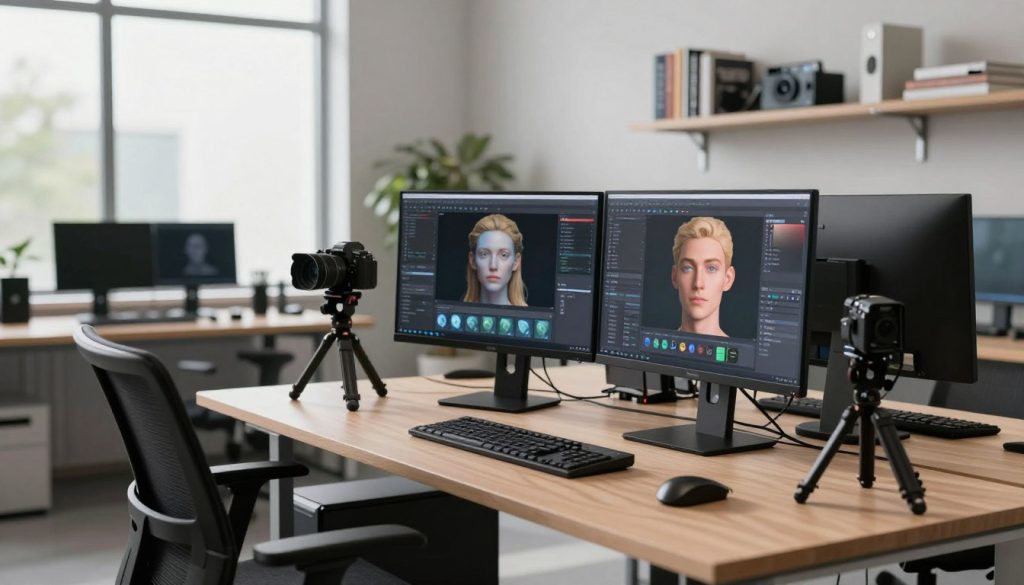
Starting your journey in high-fidelity character generation needs the right setup. A strong foundation is essential for handling big data loads in neural rendering. Without the right setup, you’ll hit roadblocks that slow down your creative work.
Hardware Requirements for Efficient Training
Your workstation’s heart is the Graphics Processing Unit (GPU). For neural rendering, you need a GPU with lots of VRAM to handle complex textures and light fields. An NVIDIA RTX 3090 or 4090 is recommended for their tensor cores.
System memory is also key for smooth data flow. Aim for at least 32GB of RAM to avoid slowdowns during training. A fast NVMe SSD is crucial for quick loading of high-resolution datasets.
Software Stacks and Frameworks to Utilize
With your hardware set up, it’s time for software. Most projects use Python and PyTorch for deep learning models. Make sure your system has the latest CUDA drivers for software and hardware compatibility.
Using a virtual environment manager like Conda keeps your dependencies organized. This prevents conflicts and makes your workflow smoother.
Configuring NVIDIA Instant-NGP for Speed
NVIDIA Instant-NGP is key for fast rendering. Start by cloning the official GitHub repository and installing C++ dependencies. Make sure your compiler is up to date to avoid build issues.
After setting up, tweak the learning rate and batch size in config files. Begin with default settings and adjust for your hardware. This approach helps you get the best performance and visual quality for your AI characters.
Mastering Neural Rendering Girls Through Advanced Training
When you focus on neural rendering girls, the path to perfection lies in fine-tuning your training parameters. Achieving high-fidelity results requires more than just raw data. It demands a sophisticated approach to how your model interprets light and form.
By refining your training pipeline, you ensure that every digital character maintains a consistent and lifelike appearance.
Defining the Neural Skin Shader
The core of a believable character is the skin shader. You must define a neural skin shader that accurately mimics the organic properties of human tissue. This involves teaching your model how light interacts with different layers of the epidermis, including absorption and scattering.
By simulating these complex physical behaviors, you create a surface that reacts naturally to environmental lighting. This level of detail is essential for neural rendering girls to avoid the dreaded “plastic” look often found in lower-quality models. Focus on capturing the subtle variations in tone and translucency that define real human skin.
Optimizing Latent Spaces for Facial Features
Consistency is the hallmark of a professional-grade model. You need to optimize your latent spaces to ensure that facial features remain stable and expressive during animation. When the latent space is well-structured, the model can interpolate between expressions without losing the character’s unique identity.
This optimization process allows for a wider range of emotional depth. It ensures that your neural rendering girls remain recognizable even when performing complex movements or changing lighting conditions. You should prioritize training sets that cover a diverse array of micro-expressions to strengthen the latent representation.
Balancing Geometry and Texture Detail
Finding the right balance between complex geometry and fine-grained texture is a technical challenge. Too much geometry can lead to performance bottlenecks, while insufficient texture detail results in a flat, unconvincing image. You must use a tiered approach to prioritize high-frequency details in areas like the eyes and lips.
The following table outlines how to adjust your training focus for optimal results:
| Feature Category | Geometry Priority | Texture Detail | Training Focus |
|---|---|---|---|
| Facial Structure | High | Low | Bone Density |
| Skin Surface | Low | High | Pore Mapping |
| Eye Region | High | High | Refraction |
| Lip Texture | Medium | High | Subsurface |
Implementing Subsurface Scattering for Realistic Skin
Subsurface scattering makes digital models look alive. Without it, your work might seem plastic and fake. It makes your characters look real by mimicking how light interacts with skin.
Simulating Light Penetration in Human Tissue
Light doesn’t just bounce off skin. It goes through the skin, scatters, and comes out somewhere else. This is why skin looks soft and glowing, especially in certain areas.
To get this right in your work, you need to set up a scattering profile. This profile should match the density of human skin. Accurate light diffusion helps avoid harsh shadows. It makes your models look more natural.
Adjusting Scattering Parameters for Different Skin Tones
Every skin tone reacts differently to light, thanks to melanin and blood vessels. You can’t use the same settings for everyone if you want your work to be realistic. Darker skin tones need a tighter scattering radius to avoid looking too transparent.
Lighter skin tones might need a wider radius to show the glow of blood vessels. Fine-tuning these parameters lets you adjust to different lighting conditions. This skill is key to making your work look professional and realistic.
Refining Skin Texture and Micro-Detailing
The secret to lifelike AI characters is in their skin texture. Base models give the structure, but it’s the small details like fine lines and pores that make them real. By focusing on these small details, you turn a static model into a believable, living being.
Applying Normal Maps and Displacement Layers
To add depth, use normal maps and displacement layers. Normal maps mimic lighting on the surface without adding extra geometry. Displacement layers change the mesh to create real bumps and ridges.
Together, these tools make a skin texture that looks real under different lights. This makes your character seem authentic from any view. Always use high-resolution maps to avoid pixelation in close shots.
Using Generative Adversarial Networks for Pore Detail
Generative Adversarial Networks, or GANs, are great for creating realistic pores. Instead of painting each pore, you train a model to make natural skin variations. This method creates stochastic patterns that look like real human skin.
Adding GAN-generated assets boosts your project’s visual quality. These networks make unique, organic surfaces that feel alive. This method saves time and gives professional results.
Avoiding the Uncanny Valley Effect
The uncanny valley happens when a character looks almost human but feels off. To avoid it, make sure your skin texture matches the character’s movements and lighting. Subtle imperfections help avoid this feeling.
Real skin is never perfectly even. Adding slight color changes and micro-wrinkles makes your character seem real. When your details match human anatomy, people will see your character as genuinely lifelike and not artificial.
Lighting Strategies for Hyper-Real Skin
Light is key to making your AI-generated characters look real. Texture maps are the base, but light makes them pop. Treat your virtual world like a pro photography studio for top-notch results.
Simulating Global Illumination in Neural Scenes
Global illumination adds soft, natural light to your scenes. It makes light bounce off surfaces like in real life. This avoids the flat look of basic renders.
Use light probes to capture your scene’s ambient data. They help your neural model understand light sources and how light scatters. This makes skin look like it’s absorbing and reflecting light, boosting realism.
Dynamic Lighting Adjustments for Character Portraits
After setting up your environment, play with dynamic lighting. Change light intensity and angles to focus on facial features. This makes your portrait stand out.
Try rim lighting to make your character pop against the background. Balancing these adjustments keeps your character looking real in any setting. Small light changes can greatly affect skin tone realism.
Post-Processing and Compositing Techniques
Mastering neural rendering girls means learning advanced compositing and color grading. After the raw render, the real magic starts in post-processing. This is where you refine the visuals and make sure your character looks top-notch.
Color Grading for Cinematic Realism
Color grading is key to a film-like look that boosts your character’s emotional impact. Adjusting contrast, saturation, and color balance can set the mood. Many artists use lookup tables (LUTs) to keep their project’s style consistent.
“The final image is not just about the raw data; it is about the story you tell through light and color.”
Blending Neural Outputs with Traditional Rendering
Combining neural outputs with traditional rendering is often needed. This mix uses neural networks’ speed and 3D assets’ precision. Focus on matching grain, depth of field, and ambient occlusion for a smooth blend.
Here’s a table of essential tools for refining your neural rendering girls:
| Tool Category | Primary Function | Benefit for Realism |
|---|---|---|
| Color Grading | Adjusting Tones | Cinematic Consistency |
| Compositing | Layer Blending | Seamless Integration |
| Denoising | Artifact Removal | Clean Texture Detail |
| Depth Mapping | Focus Control | Photographic Accuracy |
By balancing these elements, your final work will be ready for high-end use. Consistency is crucial with complex neural assets. Make sure lighting values match across all layers for a believable look.
Troubleshooting Common Rendering Artifacts
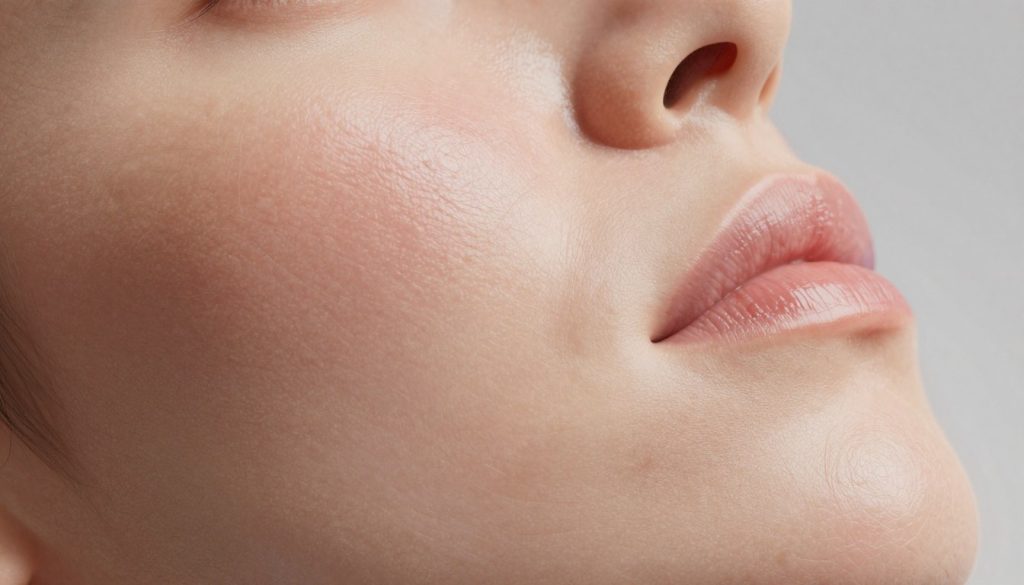
Even with a top-notch setup, you might still see visual problems in your renders. These issues can ruin the high-fidelity skin texture you’ve worked hard on. It’s crucial to know how to spot and fix these problems.
Fixing Blurry Textures and Ghosting Effects
Blurry textures often come from low-resolution training data or wrong reference image alignment. Make sure your source images have high pixel density. This helps the model capture skin texture details well. Ghosting usually means there’s a problem with how frames change over time.
To fix ghosting, improve your motion vectors or add more temporal stability during training. Consistent data preprocessing is key to avoiding these errors. Tightening your alignment ensures the neural network gets movement right across the sequence.
Correcting Color Bleeding and Noise
Color bleeding happens when light bounces wrong, tinting your character’s skin. It’s often due to too much global illumination. Adjust your bounce light and check your material shaders for light absorption.
For noise, try higher sampling rates or a better denoising pass in post-processing. Fine-tuning your latent space helps the model tell real details from random noise. By tweaking these settings, you keep your work at a professional level, even with tough technical issues.
Scaling Your Workflow for Production
Scaling your neural rendering workflow is key to moving from making one character to a whole cast. As you shift from prototypes to a professional setting, focus on efficiency to keep realism high. This means moving from manual tweaks to a more structured method.
Automating Rendering Pipelines
Automation is crucial for any production studio’s success. Scripted pipelines help process many character assets at once, without needing constant human help. Tools like Python controllers let you schedule rendering tasks, keeping your hardware busy all the time.
Using version control systems is also important. It helps keep your realism consistent across different character versions. Automated testing can catch issues early, saving you a lot of time.
Managing Computational Costs and Time
It’s vital to balance quality with budget. You might choose between buying expensive local hardware or using cloud-based GPU clusters. Cloud options are great for scaling up during busy times, but cost less when it’s slow.
Optimizing training cycles can also save money. Mixed-precision training lets you achieve visual realism faster, using less GPU time. Scheduling big rendering tasks for off-peak hours can also save you money.
| Strategy | Primary Benefit | Cost Impact |
|---|---|---|
| Cloud Rendering | Scalability | Variable |
| Local Workstations | Control | Fixed |
| Batch Automation | Efficiency | Low |
| Mixed-Precision | Speed | Low |
Conclusion
To get hyper-real skin in neural rendering, you need both technical skill and creative thinking. You now know how to work with complex data, hardware, and lighting. These skills help you make digital characters look real.
Creating high-quality digital characters takes practice and testing. Try out new things like subsurface scattering and latent space optimization. This will help you find your own style. The world of AI graphics is always changing, offering new ways to tell stories with pictures.
Use what you’ve learned in your current projects. You’ll see better texture and skin quality right away. Share your work with others to get feedback and improve. Your hard work will help shape the future of virtual humans.
FAQ
What exactly is meant by the term neural rendering girls in the context of digital art?
Neural rendering girls means creating digital humans using AI and machine learning. This is different from traditional 3D modeling. With tools like NVIDIA Instant NeRF, you can make characters look incredibly real. Their skin and lighting are done by AI, making them hard to tell from real photos on Instagram.
Why is subsurface scattering so important for achieving realism in AI characters?
Subsurface scattering (SSS) makes objects look real by simulating how light interacts with them. It prevents digital skin from looking like plastic. AI models on NVIDIA RTX hardware can now mimic this light behavior, giving your characters a natural glow.
Which software stacks should you use to begin training your own neural models?
Start with libraries like PyTorch or TensorFlow for top-notch results. For rendering, use NVIDIA Omniverse or Blender. This way, you can mix AI data with traditional cinematic looks.
How can you ensure the skin texture remains consistent across different lighting environments?
Use high-quality reference images and remove shadows with albedo extraction. This gives your AI a clear understanding of how skin should look under different lights.
What are the best hardware requirements for training high-fidelity neural rendering models?
You’ll need a powerful NVIDIA GeForce RTX 4090 or an A100 Tensor Core GPU. Lots of VRAM is also key for handling high-resolution textures and creating realistic neural rendering girls.
How do Generative Adversarial Networks (GANs) assist in the micro-detailing of facial features?
GANs like StyleGAN add fine details to a basic neural render. They create realistic pores, hairs, and skin imperfections. This makes your digital models look incredibly real.
What is the most effective way to troubleshoot blurry textures or ghosting in your renders?
Check for camera registration errors and ensure enough training iterations for clear textures. Ghosting often comes from moving subjects or uneven lighting. Keeping subjects still is crucial for sharp renders.
Can you automate the neural rendering pipeline for production-scale projects?
Yes, use Python scripts and Docker containers to automate your workflow. This helps manage costs and produce lots of realistic content.
How does color grading improve the final output of a neural render?
Color grading adds a cinematic touch to your renders. Tools like Adobe Premiere Pro or DaVinci Resolve help match the character to its environment. This makes your neural rendering girls look even more real.